Published by:

Dalibor Vuchikj
12 Apr 2021
My vision is to support companies and organizations in the development and implementation of mechanical engineering and operational projects. As a Mechanical Engineer by education, combined with a deep passion for new technologies. Specialize in offering cutting-edge digital methods and technologies, including 3D scanning, intelligent 3D modeling, documentation, 3D data processing and optimization, analysis, simulations, VR integration, and more.

Creating a Digital Twin for Kosovo B Power Plant
During a scheduled shutdown of the Kosovo B Power Plant, IN3D Technology was selected to create a Digital Twin of the furnace in its cold condition.
Our task was to process and generate accurate 3D data that could be easily accessed by the engineering team on standard computer systems, including regular laptops. The data was also prepared to support future deformation analysis.
To create the Digital Twin and accurately represent the physical condition of the furnace in a 3D CAD environment, we completed several important steps.
The project presented several challenges. Access to the furnace was limited, requiring careful planning of the scanning activities. Working in difficult conditions also required a detailed risk assessment and clear health and safety procedures. These procedures were developed by our team and approved by the client's team before the work began.
We captured the interior of the furnace using 3D laser scanning from 15 measured positions over a period of 12 hours. The scanning process generated a high-resolution point cloud together with 360° color images, providing a detailed digital record of the entire interior. From the point cloud data, we also created a high-resolution polygon mesh.
To make the 3D data easier to use on standard computer systems, we created a CAD model with solid geometry optimized for SOLIDWORKS. The model was organized into logical groups, making it easier for the engineering team to view, manage, and analyze the data.
Creating a SOLIDWORKS-friendly CAD model required us to develop a method for converting the captured data into 3D geometry that closely represented the point cloud and the real condition of the furnace.
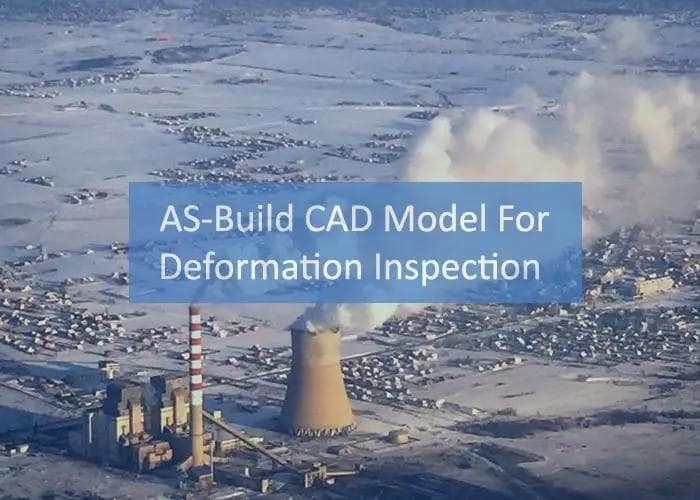
The final 3D data provided the client with a reliable basis for deformation inspection. The engineering team could compare the original detailed design CAD model of the furnace with the As-Built 3D model created from the laser scanning data.
This comparison can support future engineering analysis and help the team identify geometric changes and plan further inspections, maintenance, or other required activities more efficiently.