Published by:

Dalibor Vuchikj
17 Aug 2021
My vision is to support companies and organizations in the development and implementation of mechanical engineering and operational projects. As a Mechanical Engineer by education, combined with a deep passion for new technologies. Specialize in offering cutting-edge digital methods and technologies, including 3D scanning, intelligent 3D modeling, documentation, 3D data processing and optimization, analysis, simulations, VR integration, and more.

The Advantages of 3D Laser Scanning for Manufacturing Projects
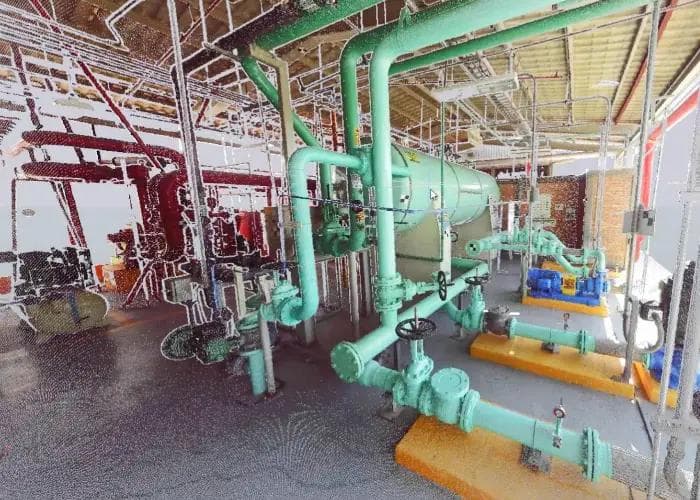
Industrial 3D laser scanning is an advanced method for capturing accurate spatial data from existing environments and converting it into detailed point clouds. Using professional 3D laser scanners, large industrial areas can be captured with millimeter-level accuracy and from a wide range of distances.
The resulting point cloud provides a highly detailed digital representation of the existing environment. It can be used as a reliable basis for 3D modeling, engineering analysis, design, documentation, inspection, and planning.
Applications
Capital Investment Planning
Precise information about existing conditions is essential when planning capital investment projects in manufacturing facilities. 3D laser scanning captures the environment where new equipment, production lines, or installations will be introduced.
Engineering teams can use this data throughout the planning and design process to better understand available space, coordinate with equipment suppliers, identify potential conflicts, and support the implementation of the investment project.
Design and Simulation
Accurate point cloud data provides a strong connection between the physical environment and the digital model. Existing conditions can be incorporated into the design process, allowing new equipment and installations to be evaluated within the actual available space.
The resulting 3D data can also support simulations and engineering analyses, helping project teams identify potential problems and evaluate different solutions before physical work begins.
Documentation for Future Reference
3D laser scanning performed at different stages of construction or installation creates valuable digital documentation of the project.
This information can later be used to locate installations, equipment, structural elements, and other components. It is particularly useful for documenting elements that will eventually be hidden behind walls, ceilings, insulation, or other closed systems, reducing the need for additional physical investigation in the future.
Installation Inspection
After installation is completed, a new scan can be compared with the detailed design or existing 3D model to verify the final installed condition.
This process helps identify deviations between the planned and actual installation and provides reliable as-built documentation. Periodic scanning can also support inspection of existing equipment and structures by documenting changes, deformation, or other differences over time.
Benefits
Industrial 3D laser scanning provides engineering teams with accurate information about existing conditions, helping improve planning, communication, design, and project control.
By integrating point cloud data into engineering workflows, companies can reduce uncertainties, identify potential issues earlier, minimize costly modifications during installation, and create reliable documentation throughout the project lifecycle.