Published by:

Dalibor Vuchikj
1 Sept 2021
My vision is to support companies and organizations in the development and implementation of mechanical engineering and operational projects. As a Mechanical Engineer by education, combined with a deep passion for new technologies. Specialize in offering cutting-edge digital methods and technologies, including 3D scanning, intelligent 3D modeling, documentation, 3D data processing and optimization, analysis, simulations, VR integration, and more.

The Advantages of Intelligent 3D Models for Mechanical Engineering
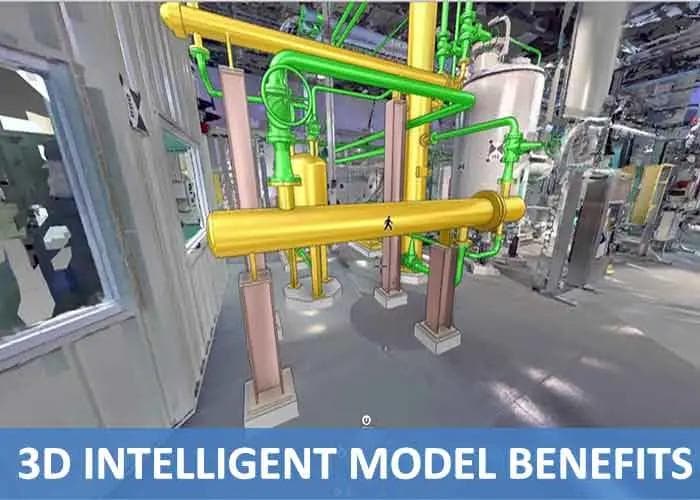
Intelligent 3D models provide significant advantages in mechanical engineering by connecting parametric 3D geometry with the physical, technical, and operational characteristics of parts, assemblies, equipment, and entire production systems. These models can be developed using specialized 3D engineering software or custom modules created for specific project and client requirements.
An intelligent 3D model can include information such as material properties, stress and displacement limits, connection requirements between components, permissible slope limits, and other technical parameters. Additional rules and project-specific data can also be integrated to support different types of engineering analysis and simulation.
When an intelligent 3D model is developed from the beginning of the initial or detailed design phase, it can provide several important advantages:
Reduction of Design Errors
Intelligent models help reduce design errors by connecting geometry with technical parameters and predefined engineering rules. This allows potential problems to be identified earlier in the design process.
Automated Documentation
Depending on the software and model configuration, project documentation such as parts lists, schematics, P&IDs, and process flow diagrams can be generated directly from the model, helping to create a more efficient engineering workflow.
Accurate Technical Analysis and Simulations
The information contained within the model can support different types of technical analysis and simulation, allowing engineers to evaluate designs and identify potential improvements before implementation.
Efficient Parts Management
Parts lists and related component information can be generated directly from the model, simplifying material planning, procurement, and equipment management.
Maintenance Planning
Intelligent 3D models can also support maintenance and overhaul planning by providing structured information about equipment, components, materials, and their relationships within the system.
Financial Analysis
By connecting components with specifications, suppliers, and pricing information, intelligent models can support faster cost estimation and financial analysis while reducing the time required to search for information across multiple sources.
By using intelligent 3D models, engineering teams can reduce design risks, improve collaboration, and simplify the transition from design to installation and operation.
Specialized engineering software can also use predefined rules to prevent incompatible components from being connected. This helps designers identify suitable components and evaluate alternative configurations or placement options during the design process.
Overall, intelligent 3D models create a structured connection between geometry and engineering information. This makes them a valuable tool for improving accuracy, efficiency, and project control throughout the mechanical engineering process.